_-_geograph.org.uk_-_5639448.jpg/500px-Rubia_tinctorum_(common_madder)_-_geograph.org.uk_-_5639448.jpg)
The Ubiquitous Root of Red’s Entangled Histories
Madder is a dye plant whose colorful history runs deep into trade, empire and science.
The Plant Humanities Lab is an innovative digital space that supports the interdisciplinary study of plants from the various perspectives of the arts, sciences, and humanities, to explore their extraordinary significance to human culture.
Humans rely on plants for our most fundamental individual and social needs: from food, medicine, and construction to our encounters with them in art and literature. Although we think of plants as rooted in place, their global travels over the millennia offer fascinating pathways into the past and illuminate some of the most burning issues of today, including legacies of colonial violence and displacement. Climate change, habitat loss, and accelerated species extinctions add to the urgency of researching plant–human interactions and acknowledging the importance of plants in our environment.
Madder is a dye plant whose colorful history runs deep into trade, empire and science.
.jpg/500px-St._John's_wort_(50050399481).jpg)
St. John's Wort has had many labels throughout history. From the Devil's Scourge to antidepressant, the plant tells the story of the interface between botany and medicine.

Olive served as place-making in Eastern Mediterranean cultures and landscapes.
.jpg/500px-Zizania_palustris_(20150206966).jpg)
Wild rice sustained Ojibwe communities as sacred food and medicine, central to their identity and migration westward. The White Earth Band granted wild rice legal personhood in tribal court to protect it from pipeline threats.

Arabica coffee shaped global commerce and culture through trade networks and coffeehouses spanning continents. Climate change now threatens cultivation lands by 54-60 percent by 2050, prompting breeding programs to develop heat-tolerant hybrid varieties using wild coffee species.
_-_Flickr_-_S._Rae.jpg/500px-Viburnum_opulus_(Guelder_Rose)_-_Flickr_-_S._Rae.jpg)
The guelder rose evolved from a prehistoric food plant into Ukraine's emblem of homeland and resistance, symbolized in the Independence Monument and patriotic song "Chervona Kalyna." Grant Allen's 1881 text first used the term "evolutionary biology" to describe the plant's deceptive sterile outer flowers that attract pollinators to fertile inner blooms.

The potato, domesticated in the Andes ten thousand years ago, shaped empires, famines, and migrations across continents through its resilience and vulnerability. During Japan's forced incarceration of Americans in World War II camps, potatoes provided sustenance while their sack strings were woven into prisoners' clothing.

White mulberry spread globally for sericulture but failed economically in America, overshadowing its native red mulberry cousin valued by Indigenous peoples. Silkworm cocoons contain 1.5 kilometers of continuous filament, making a single cocoon extraordinarily productive for silk production.

Jasmine has served as a ritual offering in Hindu and Buddhist worship, a fragrant fixture in Islamic gardens, and a symbol of love across cultures for two millennia. The plant's spiritual significance in Vrindavan is so pronounced that Hindu texts depict jasmine vines as sentient beings capable of conversing with devotees.

Passionflower carried Christian symbolism in Europe before Victorian culture reinterpreted it as a symbol of sensuality and exotic beauty. Jesuits saw Christ's Passion in the flower's morphology, later using it to justify colonial conquest across the Americas.
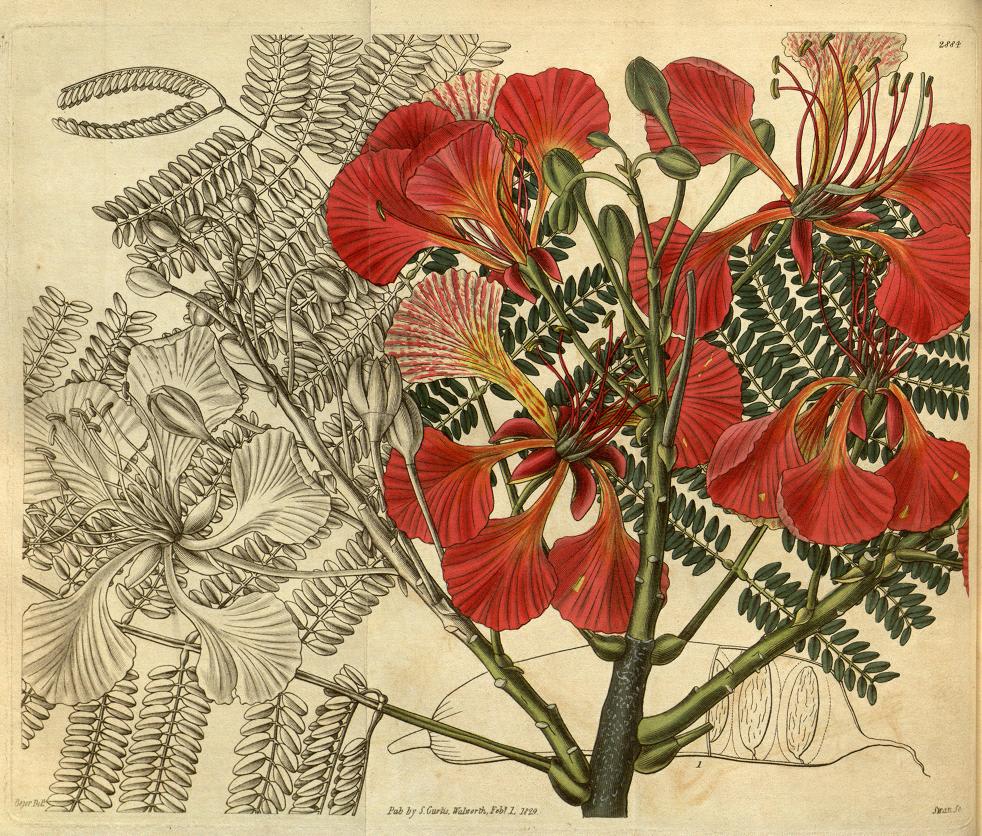
The Gulmohar (Delonix regia) traveled from Madagascar to India through nineteenth-century colonial botanical networks, becoming deeply embedded in Indian culture despite arriving only recently. The tree's name replaced that of the earlier Peacock Flower through cultural adoption, eventually symbolizing political resistance, nostalgia, and desire across South Asian literature and film.

Tamarack trees embody humility and reciprocity in Ojibwe tradition, serving as symbols for wetland conservation and ecological interconnection. Larch species were spiritually central to Siberian Evenki shamans, who called the Siberian Larch *Tuuru*—"world tree"—believing it bridged human, divine, and spirit realms.
_(3).jpg/500px-Okra_(Abelmoschus_esculentus)_(3).jpg)
Okra, cultivated across tropical regions from Southeast Asia to West Africa, became central to African diasporic survival and cultural identity in the Americas. Enslaved Africans likely transported okra seeds via ships during the Middle Passage to ensure their own sustenance.
Madder is a dye plant whose colorful history runs deep into trade, empire and science.
St. John's Wort has had many labels throughout history. From the Devil's Scourge to antidepressant, the plant tells the story of the interface between botany and medicine.
Olive served as place-making in Eastern Mediterranean cultures and landscapes.
Wild rice sustained Ojibwe communities as sacred food and medicine, central to their identity and migration westward. The White Earth Band granted wild rice legal personhood in tribal court to protect it from pipeline threats.
Arabica coffee shaped global commerce and culture through trade networks and coffeehouses spanning continents. Climate change now threatens cultivation lands by 54-60 percent by 2050, prompting breeding programs to develop heat-tolerant hybrid varieties using wild coffee species.
The guelder rose evolved from a prehistoric food plant into Ukraine's emblem of homeland and resistance, symbolized in the Independence Monument and patriotic song "Chervona Kalyna." Grant Allen's 1881 text first used the term "evolutionary biology" to describe the plant's deceptive sterile outer flowers that attract pollinators to fertile inner blooms.
The potato, domesticated in the Andes ten thousand years ago, shaped empires, famines, and migrations across continents through its resilience and vulnerability. During Japan's forced incarceration of Americans in World War II camps, potatoes provided sustenance while their sack strings were woven into prisoners' clothing.
White mulberry spread globally for sericulture but failed economically in America, overshadowing its native red mulberry cousin valued by Indigenous peoples. Silkworm cocoons contain 1.5 kilometers of continuous filament, making a single cocoon extraordinarily productive for silk production.
Jasmine has served as a ritual offering in Hindu and Buddhist worship, a fragrant fixture in Islamic gardens, and a symbol of love across cultures for two millennia. The plant's spiritual significance in Vrindavan is so pronounced that Hindu texts depict jasmine vines as sentient beings capable of conversing with devotees.
Passionflower carried Christian symbolism in Europe before Victorian culture reinterpreted it as a symbol of sensuality and exotic beauty. Jesuits saw Christ's Passion in the flower's morphology, later using it to justify colonial conquest across the Americas.
The Gulmohar (Delonix regia) traveled from Madagascar to India through nineteenth-century colonial botanical networks, becoming deeply embedded in Indian culture despite arriving only recently. The tree's name replaced that of the earlier Peacock Flower through cultural adoption, eventually symbolizing political resistance, nostalgia, and desire across South Asian literature and film.
.jpg/500px-170411_559_Encinitas_-_San_Diego_Botanic_Gdn,_entrance_gdn,_Melaleuca_viridiflora_var_rubriflora_Paperbark_Tree_(34456955761).jpg)
Melaleuca quinquenervia served colonial powers as a landscape tool, later becoming Florida's most destructive wetland invader. Ironically, the same traits that made it valued for draining swamps—rapid growth and prolific seeding—enabled its transformation from champion tree to ecological enemy within a century.